Showing posts with label power supply. Show all posts

Friday, January 4, 2013

Control 12V to 24V DC- DC Converter

This simple circuit is a DC-DC converterthat converting up 12V source to a 24V. It can be used to run radios,small lights, relays, horns and other 24V accessories from a 12Vvehicle with a maximum draw of about 800mA.
 The Schematic 12V to 24V DC- DC Converter

This DC-DC Convertercan be used to charge one 12V battery from another, or step up thevoltage just enough to provide necessary overhead for a 12V linearregulator. Using one op-amp as a square wave oscillator to ring aninductor and another op-amp in a feedback loop, it won't drift aroundunder varying loads, providing a stable 24V source for manyapplications. With a wide adjustment in output this circuit has manyuses.

Parts List
R1-R4,R7-R8 100K 1/4W Resistor
R5 470 Ohm 1/2W Resistor
R6 10K Linear Pot
C1 0.01uF Mylar Capacitor
C2 0.1uF Ceramic Disc Capacitor
C3 470uF 63V Electrolytic Capacitor
D1 1N4004 Rectifier Diode
D2 BY229-400 Fast Recovery Diode See Notes
Q1 BC337 NPN Power Transistor
U1 LM358 Dual Op Amp IC
L1 See Notes
MISC Board, Wire, Socket For U1, Case, Knob For R6, Heat sink for Q1

DC- DC Converter Notes
1. R6 sets the output voltage. This can be calculated by Vout = 12 x (R8/(R8+R7)) x (R6B/R6A).
2. L1 is made by winding 60 turns of 0.63MM magnet wire on a toroidal core measuring 15MM (OD) by 8MM (ID) by 6MM (H).
3.D2 can be any fast recovery diode rated at greater then 100V at 5A. Itis very important that the diode be fast recovery and not a standardrectifier.
4. Q1 will need a heat sink.
read more "Control 12V to 24V DC- DC Converter"

Monday, December 31, 2012

Control Variable DC Power Supply With LM317

This DC power supply circuit is adjustable using IC Voltage Regulator LM317. LM317 is a versatile and highly efficient 1.2-37V voltage regulatorthat can provide up to 1.5A of current with a large heat sink. It'sideal for just about any application. This was my first workbench powersupply and I still use it.

Since LM317 is protectedagainst short-circuit, no fuse is necessary. Thanks to automaticthermal shutdown, it will turn off if heating excessively. All in all,a very powerful (and affordable!) package, indeed.

Although voltage regulator LM317 is capable of delivering up to 37V, the DC power supplyoutput circuit here is limited to 25V for the sake of safety andsimplicity. Any higher output voltage would require additionalcomponents and a larger heat sink.

Make sure that theinput voltage is at least a couple of Volts higher than the desiredoutput. It's OK to use a trim-pot if you're building a fixed-voltagesupply.

Problems:
Follow all the safety precautions when working with mains voltage. Insulate all connections on the transformer.
read more "Control Variable DC Power Supply With LM317"

Friday, December 28, 2012

Control 6A, 5 Volt Power Supply

The standard variable voltage regulator type LM150 is fairly easily available, but at times its out, which is limited to about 3 amperes, may prove to e a limiting factor to its utility, nut the simple modification describe here allows the to be enhanced to about 6 amperes. The circuit has inbuilt safe area protection and thermal overload protection.The circuit has been tested for lone regulation of the order of about 0.01% volt and load regulation of about 0.1% volt.
The circuit works on principle similar to the compact 10A power supplies. The two LM150 regulators are wired in parallel mode with  IC3 which controls them. The output voltage is given by the relation
Vout=1,25x(1+R5/R4) volts. The input voltage may lie anywhere in the range of 12 to 30 volts.

The IC must be adequately heat sinked in order to obtain full output current all over the operative temperature range 

The circuit 6A, 5 volt Power Supply
read more "Control 6A, 5 Volt Power Supply"

Thursday, December 27, 2012

Control High Current Regulated Supply

The high current regulator below uses an additional winding or a separate transformer to supply power for the LM317 regulator so that the pass transistors can operate closer to saturation and improve efficiency. For good efficiency the voltage at the collectors of the two parallel 2N3055 pass transistors should be close to the output voltage. The LM317 requires a couple extra volts on the input side, plus the emitter/base drop of the 3055s, plus whatever is lost across the (0.1 ohm) equalizing resistors (1volt at 10 amps), so a separate transformer and rectifier/filter circuit is used that is a few volts higher than the output voltage. The LM317 will provide over 1 amp of current to drive the bases of the pass transistors and assumings a gain of 10 the combination should deliver 15 amps or more. The LM317 always operates with a voltage difference of 1.2 between the output terminal and adjustment terminal and requires a minimum load of 10mA, so a 75 ohm resistor was chosen which will draw (1.2/75 = 16mA). This same current flows through the emitter resistor of the 2N3904 which produces about a 1 volt drop across the 62 ohm resistor and 1.7 volts at the base. The output voltage is set with the voltage divider (1K/560) so that 1.7 volts is applied to the 3904 base when the output is 5 volts. For 13 volt operation, the 1K resistor could be adjusted to around 3.6K. The regulator has no output short circuit protection so the output probably should be fused.
read more "Control High Current Regulated Supply"

Thursday, July 26, 2012

Schematic Photovoltaic Solar Battery Regulator and Load Controller

This Solar Battery Regulator project allows solar cell arrays to be connected to either conventional lead-acid, sealed lead-acid, or lithium storage batteries without fear of overcharging. The project can be used to drive two different electrical loads from the batteries at two different charge states to maximise power usage efficiency.

Photovoltaic Solar Battery Regulator

How to Use It
Applying a load only to the secondary output, you can choose to charge up the batteries to near maximum and dump excess power into the load only to stop overcharging. Applying the load to the main load output extracts as much power from the system immediately as it is generated. For camping fridge operation one might typically connect to the main load output most of the time, possibly switching to the secondary output if power was needed for some other purpose on the main load e.g. charging a mobile phone battery, or if it was desired to store up charge for a period of prolonged fridge operation.

Here is the project schematic. No MCU is needed for this project.


read more "Schematic Photovoltaic Solar Battery Regulator and Load Controller"

Monday, February 14, 2011

Schematic Mini PSU for Breadboard


The purpose of the project is to create a 5V mini Power Supply Unit for breadboard. The project can be connected to 8-18 DC power source, or 9V battery. During construction, put the components in as tight as you can, while verifying that you can in fact complete the circuit on the underside of the board without adding any wires. The main component in this project is voltage regulator LM 7805.

To build this you need:

Some electronics skills. Soldering, knowing how to follow a circuit diagram etc..
1 voltage regulator LM 7805
1 10uF capacitor
1 1000uF capacitor (you can use any big electrolyte capacitor here, doesn't have to be exactly 1000uF)
1 100nF capacitor
1 LED for power on indication
1 resistor to take the voltage down from 5V to whatever your LED runs at
1 screw terminal for the input voltage
1 switch for input voltage on/off
1 perfboard, the type with copper eyes, not stripes
1 2-pin connector to plug the unit into the breadboard
read more "Schematic Mini PSU for Breadboard"

Friday, April 2, 2010

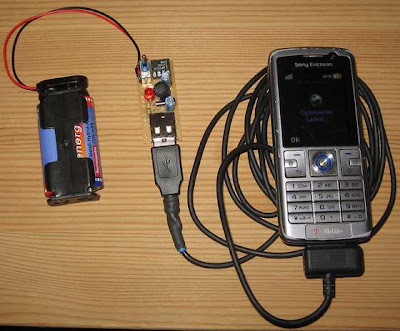
Schematic Small USB Device Charger

USB Battery charger

This advance tiny USB battery powered charger is handy tools for your need. You can use it to charge almost all devices which are charged via USB, like iPods or mobile phones, with only two AA-Cells. The Most important compenent of the cicuit LT1301. This is a small step up converter for to build switching mode power supplys with only a few external components.

Download :
Schematic and document

tag : USB Charger, Battery Powered Charger, Small Charger (src)


read more "Schematic Small USB Device Charger"

Thursday, February 18, 2010

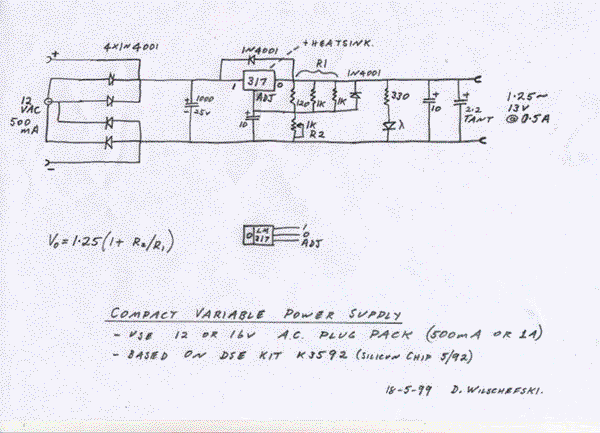
Schematic Compact Variable Power Supply


This is a handy little power supply that can provide a voltage range of 1.25 to 13 volts and current up to 500 mA. The supply, created by Don Wilschefski, is housed in a small plastic enclosure 90 x 55 x 32 mm.

Download

schematic

search term : Power Supply, Handy supply, Variable PSU, analog project (src)

read more "Schematic Compact Variable Power Supply"

Sunday, February 14, 2010

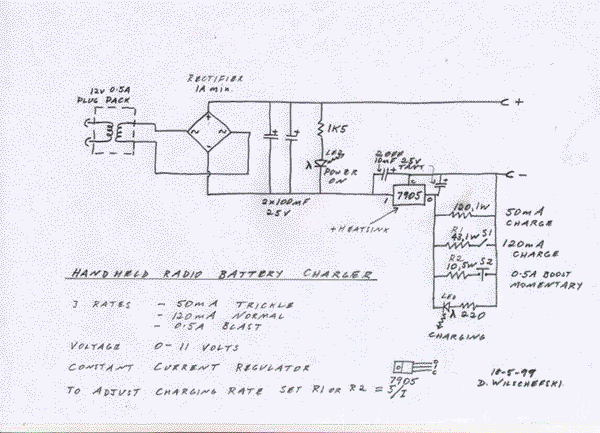
Schematic Battery Charger for Hand Held Radio

Battery Charger for Hand Held Radio
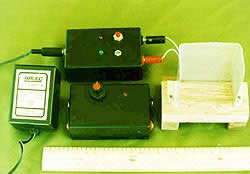
This is a handy little charger that can provide a charging current of up to 120 mA continuously for batteries in the range up to 12 volts. This project inspired by 12 volt 500 mA plug pack at an amateur auction. Two potentially useful projects resulted from this plug pack. The other is a variable power supply. The supply is housed in a small plastic enclosure 90 x 55 x 32 mm.


Download :


Schematic

search term : Battery Charger, Hand held Radio charger, Analog Project (src )

read more "Schematic Battery Charger for Hand Held Radio"